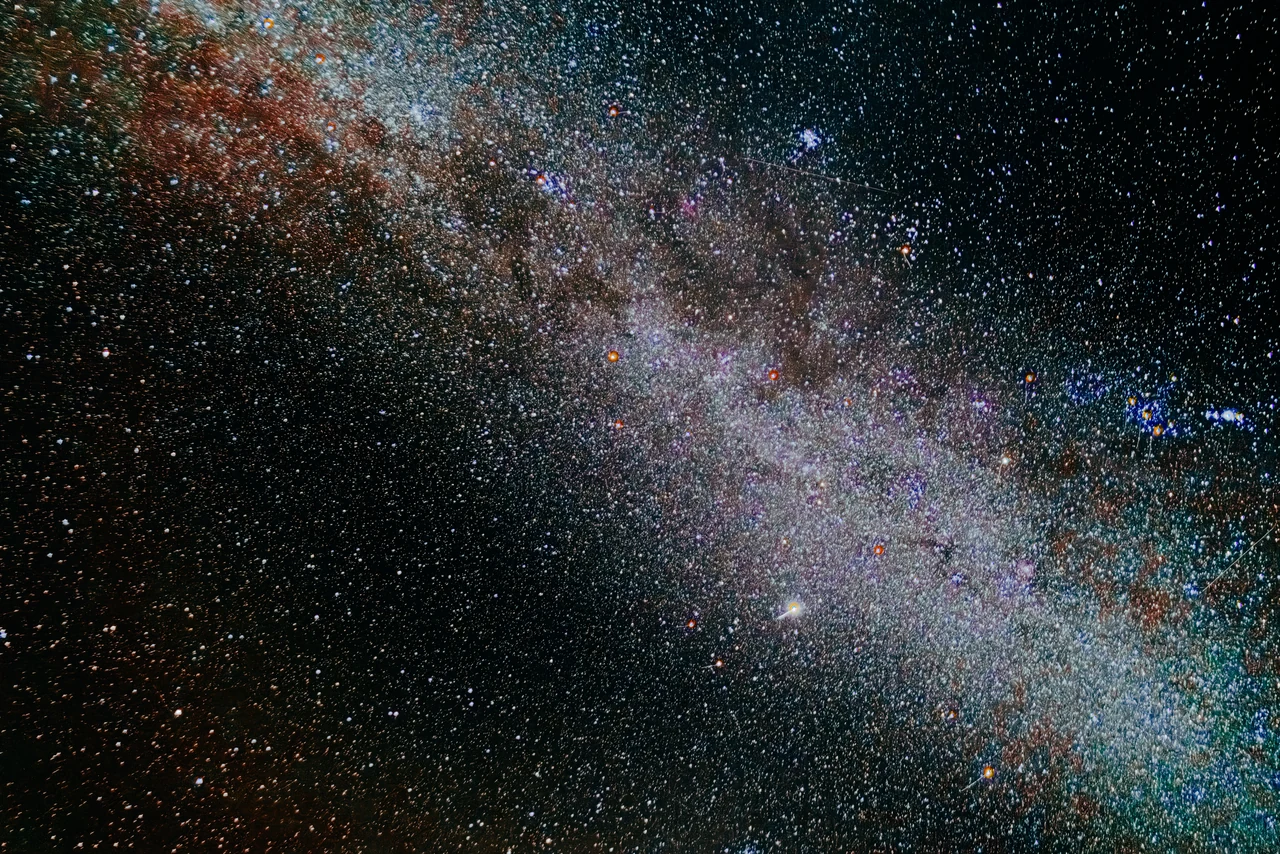
I wanted to identify the stars in a Milky Way photograph I had taken. A question about how many points of light it contained grew into experiments with star detection, star catalogs, and image matching—and eventually an interactive sky map.
The photograph was already something to look at. I wanted to understand more of what I was looking at. The catalog matches are still a work in progress; I do not yet have a verified identification for every star in this image.
From points of light to a star catalog
The first attempts at detecting stars left me asking about the dense region through the Milky Way. Could I match points in the photograph to a star catalog, work out which part of the sky the camera was facing, and build a view that let me explore the connections?
That led to experiments with brighter reference stars, image alignment, blur, and a catalog overlay that followed the photograph as I zoomed. Each step introduced another detail to get right. Detecting a bright point gives me a candidate; identifying it requires a match to a catalog.
What plate solving adds
Plate solving connects positions in an astronomical image to coordinates on the sky. It belongs to astrometry, the measurement of celestial positions. A solver compares patterns of stars in the image with a catalog to determine where the camera was pointing, the image scale, and its orientation.
Astrometry.net is an established tool for this step. Its solver accepts an image or a list of detected source positions and searches for a matching star pattern. That is a useful reference for understanding what a checked solution should establish; the experiments described here do not establish a successful plate solve of my photograph.
What you can explore here
The interactive Sky Map projects a bundled catalog of bright stars for a place and a time. You can move around the sky and explore it on a phone or desktop. It grew out of the photograph, but it does not accept photo uploads or automatically identify the stars in this image.
A convincing-looking overlay still needs checking. A useful next check would compare catalog positions with several reference stars across the photograph, including stars that were not used to align it. Until that check is done, the map and the photograph are connected experiments, with the identification question still open.
I like the connection between the two activities: taking a picture because something is beautiful, then staying with it long enough to find another reason to look.